
“The Money-Making Trough: 10 Small Mistakes Costing Dairy Farmers Thousands of Liters of Milk a Year”
The feed bunk is the center of activity for the dairy cow. The quality of feed bunk management directly impacts feed intake, herd health, milk yield, and farm profitability. Seemingly minor errors in daily management can sometimes result in losses amounting to thousands—or even tens of thousands—of shekels annually.

The good news is that most of these issues can be prevented by strictly adhering to proper management practices.
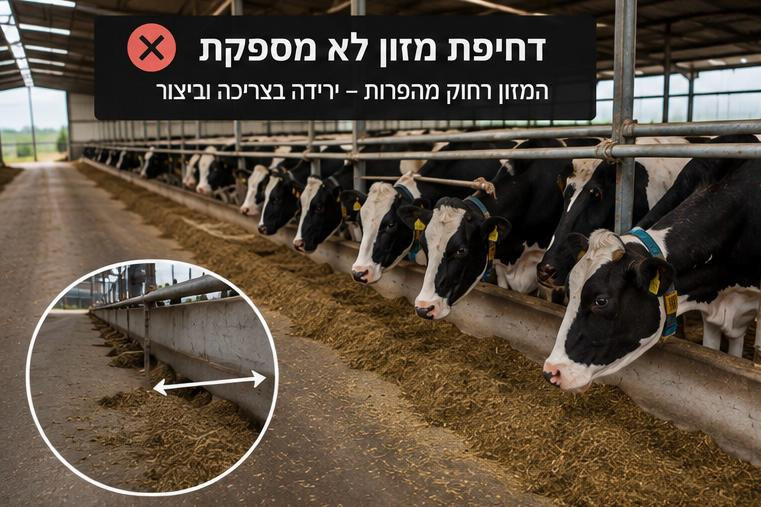
Mistake 1: Insufficient feed pushing throughout the day
Cows prefer having feed accessible to them around the clock.
When feed moves away from the bunk:
* Cows eat less.
* Dry matter intake drops.
* Milk yield suffers.
The solution:
* Push up the feed several times a day.
* Use a feed-pushing robot whenever possible.
* Ensure feed is available during the night as well.
Mistake 2: Lack of uniformity in the TMR (Total Mixed Ration)
When the mixture is not uniform:
* Cows sort through the feed.
* Some cows consume more starch.
* Others receive less energy.
The result:
* A drop in production.
* Increased risk of rumen acidosis.
* Fluctuations in milk fat percentage.
The solution:
* Ensuring the correct loading sequence in the mixer.
* Appropriate mixing time.
* Periodic checks for mixture uniformity.
Mistake 3: Dirty feed bunk
Spoiled feed residues can:
* Reduce appetite.
* Lead to mold and bacterial growth.
* Harm herd health.
The solution:
* Daily cleaning of the feed bunk.
* Removing old residues before distributing fresh feed.
* Maintaining hygiene, especially during the summer.

Mistake 4: Overcrowding at the feed bunk
When the number of cows exceeds the number of feeding spaces:
* Weaker cows eat less.
* Feeding time is reduced.
* Competition and stress arise.
The solution:
* Allocating sufficient space for each cow.
* Grouping cows by age and production level.
* Proper planning of the feeding area.
Mistake 5: Irregular feed delivery times
Cows thrive on routine.
Changes in feeding times can lead to:
* Reduced feed intake.
* Stress.
* Impaired milk production.
The solution:
* Stick to a fixed schedule.
* Minimize changes as much as possible.
Mistake 6: Heated or spoiled feed
During the Israeli summer, the feed mixture can heat up rapidly.
The effects:
* Reduced feed palatability.
* Reduced intake.
* Impaired production.
The solution:
* Distribute smaller portions.
* Use preservatives as needed.
* Feed during cooler hours.
Mistake 7: Lack of water near the feed bunk
Water is the most important nutrient for a lactating cow.
A lack of water leads to:
* Reduced feed intake.
* Reduced milk yield.
* Compromised cow welfare.
The solution:
* Providing clean water at all times.
* Regular cleaning of water troughs.
* Checking water flow rates.
Mistake 8: Feed mix not suited to the production stage
A cow in early lactation requires a different feed composition than a cow approaching the dry-off period.
When the entire herd receives the same mix:
* Some cows receive too little energy.
* Others receive too much.
The solution:
* Grouping by feeding requirements.
* Tailoring the ration to physiological needs.
Mistake 9: Ignoring particle sorting
Feed particle size affects rumen activity.
Particles that are too long:
* Encourage sorting.
Particles that are too short:
* Increase the risk of acidosis.
The solution:
* Use of the Penn State Separator.
* Periodic checks of the ration structure.
Mistake 10: Lack of data monitoring
Many dairy farms still rely solely on observation.
Without systematic measurement, it is difficult to identify:
* A drop in feed intake.
* A decline in feed efficiency.
* Operational issues.
The solution:
* Daily tracking of feed intake.
* Monitoring milk yield.
* Use of computerized management systems.
Economic Impact
Even a small drop of 0.5–1 kg in daily dry matter intake per cow can lead to a significant reduction in milk yield.
In large herds:
* Loss of many liters of milk per day.
* Increased treatment and morbidity costs.
* Reduced overall profitability.

Summary
Bunk management involves much more than simply placing feed in front of the cows. It is a key factor influencing:
Feed intake.
Rumen health.
Milk yield.
Fertility.
Farm profitability.
Most common errors can be prevented by adhering to work routines, monitoring data, and utilizing advanced technologies. Sometimes, a minor change in bunk management can lead to a significant improvement in the performance of the entire herd.
*It is always advisable to consult a qualified veterinarian.


