
Sensors and cameras for early disease monitoring in poultry houses
The poultry farming sector has been undergoing a technological revolution in recent years. While poultry farmers once relied primarily on physical inspections and visual identification of issues, smart systems based on sensors, cameras, and artificial intelligence now enable the detection of early signs of disease—even before they are visible to the human eye.

Early detection of health issues enables prompt treatment, reduces mortality, improves poultry welfare, and minimizes economic losses.
Why is early disease detection important?
Many diseases spread rapidly within the poultry house.
A delay of just a few days in identifying the problem can lead to:
* A sharp drop in feed and water intake.
* Slowed growth rates.
* Impaired feed conversion ratios.
* Increased mortality.
* High treatment costs.
* Significant economic losses.
The earlier a problem is identified, the greater the chance of minimizing the damage.
How do smart monitoring systems work?
The systems integrate multiple data sources:
Video cameras
Cameras installed in the poultry house continuously monitor:
* Poultry movement.
* Flock behavior.
* Distribution of the birds within the facility.
* Access to feed and water.

Artificial intelligence systems analyze the data and detect anomalies indicating a potential problem.
Temperature and humidity sensors
Changes in environmental conditions directly affect poultry health.
The sensors monitor:
* Air temperature.
* Relative humidity.
* Heat stress.
* Ventilation quality.
When an anomaly is detected, the system issues a real-time alert.
Water Consumption Sensors
One of the first signs of many diseases is a decrease in water consumption.
The system can detect:
* A sudden drop in water intake.
* Changes in consumption patterns.
* Malfunctions in the water system.
In many cases, this serves as an early indicator, appearing before clinical signs manifest.
Feed Intake Sensors
Feed intake is also an important indicator of flock health.
The system monitors:
* Feeding quantities.
* Feeding times.
* Rate of feed intake.
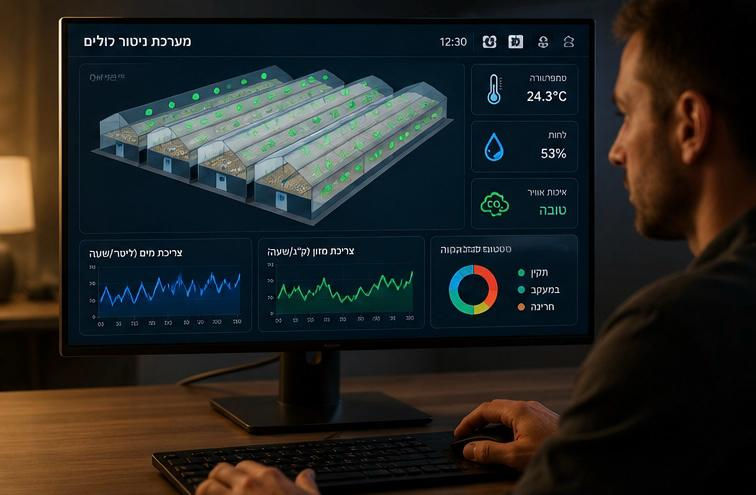
An abnormal drop may indicate a developing illness.
Artificial Intelligence in the Service of the Poultry House
AI systems are capable of analyzing thousands of data points every hour.
They detect:
* Behavioral changes.
* Decreased activity.
* Abnormal clustering.
* Signs of distress.
* Irregular movement patterns.
The system sends an alert to the poultry house manager's mobile phone, enabling a rapid response.
Sound and Breathing Monitoring
Another innovative technology is based on smart microphones.
The system listens for:
* Coughing.
* Wheezing.
* Voice changes.
* Sounds of distress.
Advanced algorithms enable the detection of respiratory disease outbreaks at an early stage.
Benefits for the Grower
Reduced Mortality
Early detection enables rapid treatment and prevents widespread spread.
Improved Performance
A healthy flock achieves:
* Higher weight.
* Better feed utilization.
* Improved uniformity.
Cost savings
* Fewer treatments.
* Fewer losses.
* Reduced antibiotic use.
Data-driven decision-making
The grower receives continuous, accurate information instead of relying solely on visual assessment.
Challenges in Implementing the Technology
Despite the advantages, there are several challenges:
* Initial installation costs.
* The need for a stable internet connection.
* Staff training.
* Ongoing equipment maintenance.
* Adapting the system to the specific type of poultry house.
However, costs are gradually decreasing, and the technology is becoming increasingly accessible.
The Future Is Already Here
Many experts estimate that within a few years, most modern poultry houses will shift to data-driven management.
The next generation of systems is expected to include:
* Disease detection at the individual bird level.
* Thermal cameras.
* Autonomous robots.
* Disease prediction using artificial intelligence.
* Full management of the poultry house via mobile phone.

Summary
Sensors, cameras, and artificial intelligence are transforming poultry house management worldwide. Instead of waiting for clear signs of illness to appear, it is now possible to detect issues at an early stage, respond quickly, and significantly improve flock health and profitability.
For producers aiming to remain competitive in the modern era, smart monitoring technologies are evolving from advanced tools into a new industry standard.
*It is always advisable to consult a qualified veterinarian.


